Original research · Bookkeeping
We let five free trials die . Only one gave the data back.
Original research: we ran five bookkeeping software trials to their real expiry date and screenshotted every warning email, every cancellation screen and every locked-out login. The two tools holding our credit card were the only ones that said what happens to your data. The three that asked for no card locked us out without a word, and one of them took the client down too.
Some links below are affiliate links — if you subscribe through one, we earn a commission at no extra cost to you. It never changes a verdict; every tool runs the same test books. Full disclosure
Every software review tells you what a trial is like on day one. We wanted to know what it is like on the last day, so we did something slightly strange: we signed up for five tools, ran our test client’s books through each one, and then let every trial run to its actual expiry date with a screenshot open.
Two of the five held a credit card. Three did not.
The two holding a card were the only ones that told us what would happen to our data. Both warned us roughly a week ahead. Both stated, on screen, what we would lose and when. One of them still lets us read our books a year later.
The three that asked for no card at signup, the ones whose pricing pages advertise “no credit card required” as a kindness, told us nothing. All three ended in a wall. None offered an export on the way out. One of them took our fictional client down with it, leaving them staring at an error code and an instruction to contact the vendor’s support desk about their own bookkeeper’s paperwork.
That is not the result we expected, and it changes how we would advise anyone to run a trial.
How we tested
Five trials, started between August 10 and August 16, 2026, each loaded with the same fictional landscaping company’s quarter of books. We changed no defaults, enabled no reminders, and made no attempt to extend or negotiate anything. Then we watched.
Where a trial could charge us, we cancelled a few days before the fuse and recorded the cancellation flow screen by screen. Where a trial could not charge us, we simply let it lapse and logged in the next morning. Every email either vendor sent in the window was logged with its timestamp, including a check of the spam folder, which turned out to matter more than we assumed.
The five: QuickBooks Online (Essentials, $85/mo), Xero (Growing, $55/mo), FreshBooks (Plus, $43/mo), Content Snare (trialled on Pro features; entry tier $42/mo) and Ignition (entry tier $49/mo). Prices verified on each vendor’s own page in August 2026 and tracked, with dates, on our pricing tracker.
Who takes a card
Of the ten tools in our tracker, exactly two demand a credit card to start a free trial: QuickBooks Online and Xero. Neither lets you remove it afterward. What you have signed up for, in both cases, is a subscription with the first period discounted to nothing.
Xero says so outright, which we appreciated more the longer this experiment ran:
“Your auto-renewing subscription started on 10-Aug-2026 and your first month is free. Unless you cancel before 11-Sep-2026, your saved payment details will be charged.”
That is not a trial. It is a subscription with a fuse, and the honest framing is useful because it tells you what discipline the next thirty days require.
The warning
All five vendors sent something before the end. They were not remotely equal.
| Tool | Notice sent | What it claimed | Actual time remaining | Where it landed |
|---|---|---|---|---|
| Xero | Sep 1 | “7 days remaining” | 10 days to the charge date it named | Inbox |
| QuickBooks Online | Sep 3 | “in 7 days” | 7 days — exact | SPAM |
| FreshBooks | Sep 6 | No date at all | 4 days | Inbox |
| Content Snare | Sep 4 | “In 2 days” | 2 days — exact | Inbox |
| Ignition | Aug 29 | “expires today” | Same day | Inbox |
Xero’s is the best warning any tool in this lab has sent, and it still contains an error. It arrived unprompted, named the exact charge date, and put a Manage subscription control in the email itself:
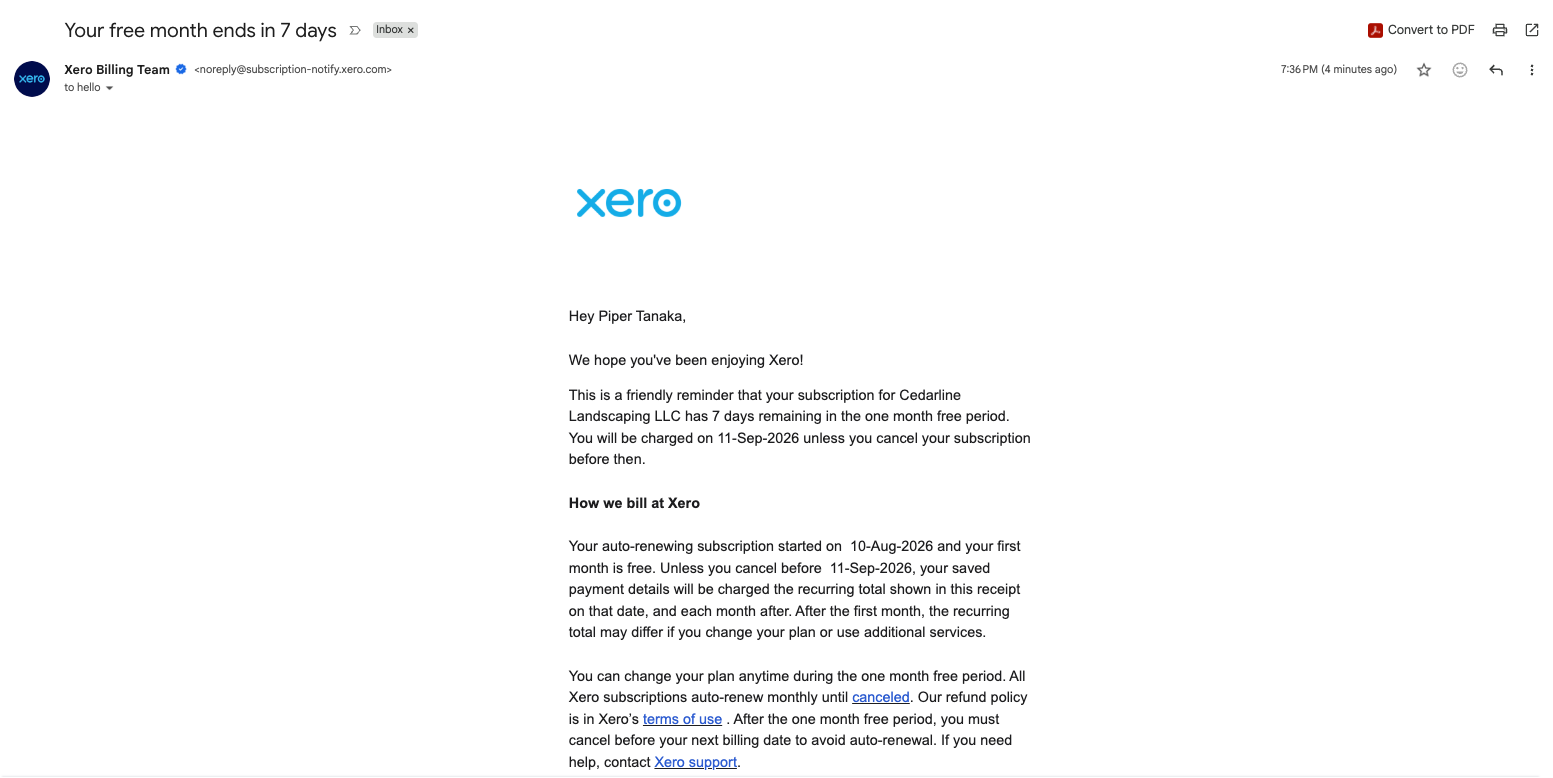
Read the subject line against the date in the body. The email says seven days remaining. It was sent on September 1 and names September 11 as the charge date, which is ten days later. The free period itself ran to September 10, which makes nine. The countdown is wrong by two or three days in the customer’s favour, so nobody gets charged by trusting it, and we would rather have a vendor err in that direction. But a billing email whose own two numbers disagree is worth knowing about, because the fix is to trust the date and ignore the countdown.
Intuit’s equivalent was arithmetically perfect and told us more. It named the charge date, the amount, the plan, the last four digits of the card and its expiry, and the billing address:
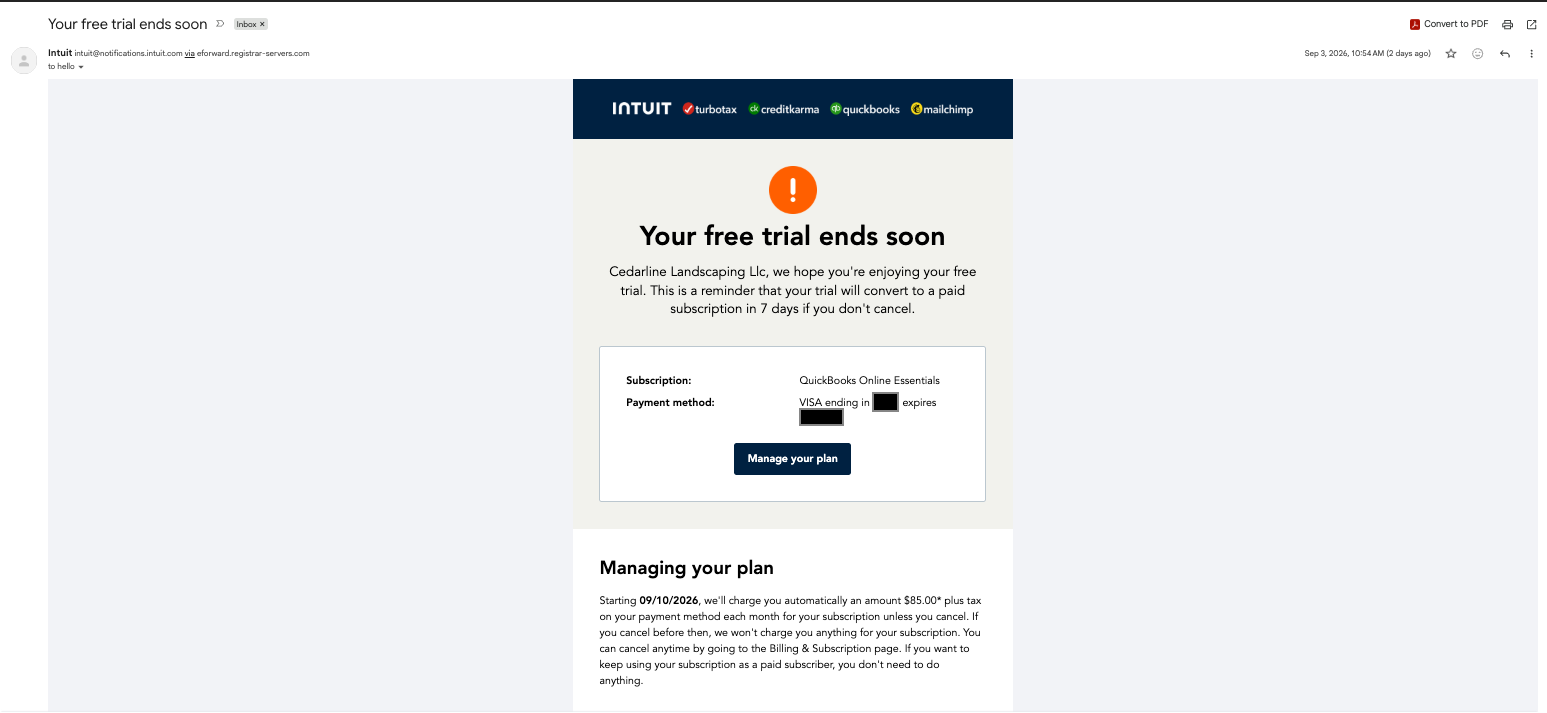
We found it four days late, in spam, on the morning we cancelled. Before that we had recorded, in our own notes, that QuickBooks had sent no warning at all. We were wrong, and the way we were wrong is instructive.
Our test mailbox forwards to Gmail. Xero’s warning came through that forwarder carrying a signature Gmail could verify as Xero’s, and landed in the inbox. Intuit’s came through the same forwarder carrying only the forwarder’s signature, so Gmail saw mail claiming to be from Intuit that it could not verify, and filed it accordingly.
We cannot tell from outside whether Intuit never signed the message or whether the signature broke in transit, and we are not claiming Intuit’s billing mail fails for everyone. What we can say is that two vendors sent warnings down the identical path on consecutive days and only one arrived. A warning your mail provider cannot authenticate is a warning a lot of people will never see.
FreshBooks deserves its own paragraph for the opposite reason. Across the whole trial it sent twelve emails: a welcome, a verification, and a nine-message feature tour covering bank imports, reports, teams, payments and payroll. The closest thing to a warning was a feature-tour message four days before the end whose preview line read “time is running out,” naming no date. The email actually titled “Reminder: your free trial is ending” arrived the morning after the trial had already expired, and its headline said “Time’s up!” directly above a line reading “Your trial is almost over.” Both sentences in one email, one of them wrong.
Cancelling, for the two that could charge us
This step only exists for the tools holding a card, and the two of them handled it very differently.
Xero took three screens and one click that mattered. The cancel control sits in the row menu on the Subscriptions page, in plain sight beside Change plan and View billing account. The confirmation dialog states the outcome before you commit: the subscription ends on a named date, the organisation becomes inaccessible to all users after it, you should export your data first, and the organisation can be reactivated later. There was a ten-option reason survey, no retention offer, no discount, and no second “are you sure.”
QuickBooks took four screens and two confirmations, and put a sunk-cost display in front of the first one: four tiles counting the invoices, transactions and customers we would be walking away from, all of them real, followed by a single button offering a downgrade to the $38 tier. The cancel link was below the fold. There was also a 50%-off banner running across the top of the app during the trial, visible only in-app, never mentioned in any email.
Push past all that, though, and QuickBooks does something no other tool in this experiment did. It tells you exactly what you are about to lose:
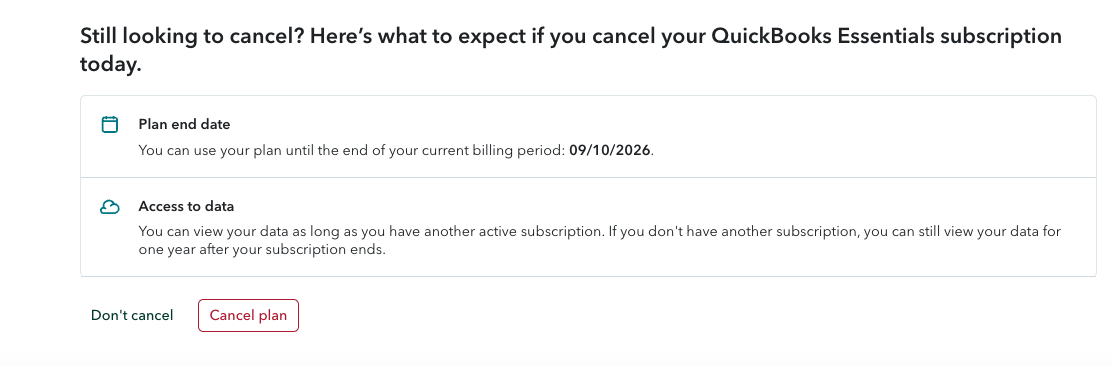
A plan end date and a retention period, in plain language, before the button. Then, on the confirmation screen, an export link.
The last day
Here is what each tool actually did when its clock ran out.
| Tool | Card held | Access after expiry | Data terms stated anywhere |
|---|---|---|---|
| QuickBooks Online | Yes | Read-only for one year — reports still run | Yes, on screen and dated |
| Xero | Yes | Organisation locked; Reactivate is the only route | Partly — “export first”, no retention period |
| FreshBooks | No | Checkout wall, no dashboard | None |
| Content Snare | No | Billing wall, navigation removed | None |
| Ignition | No | Firm locked out and the client’s link dead | None |
QuickBooks: the only real read-only mode
On the stated end date, logging in produced this:
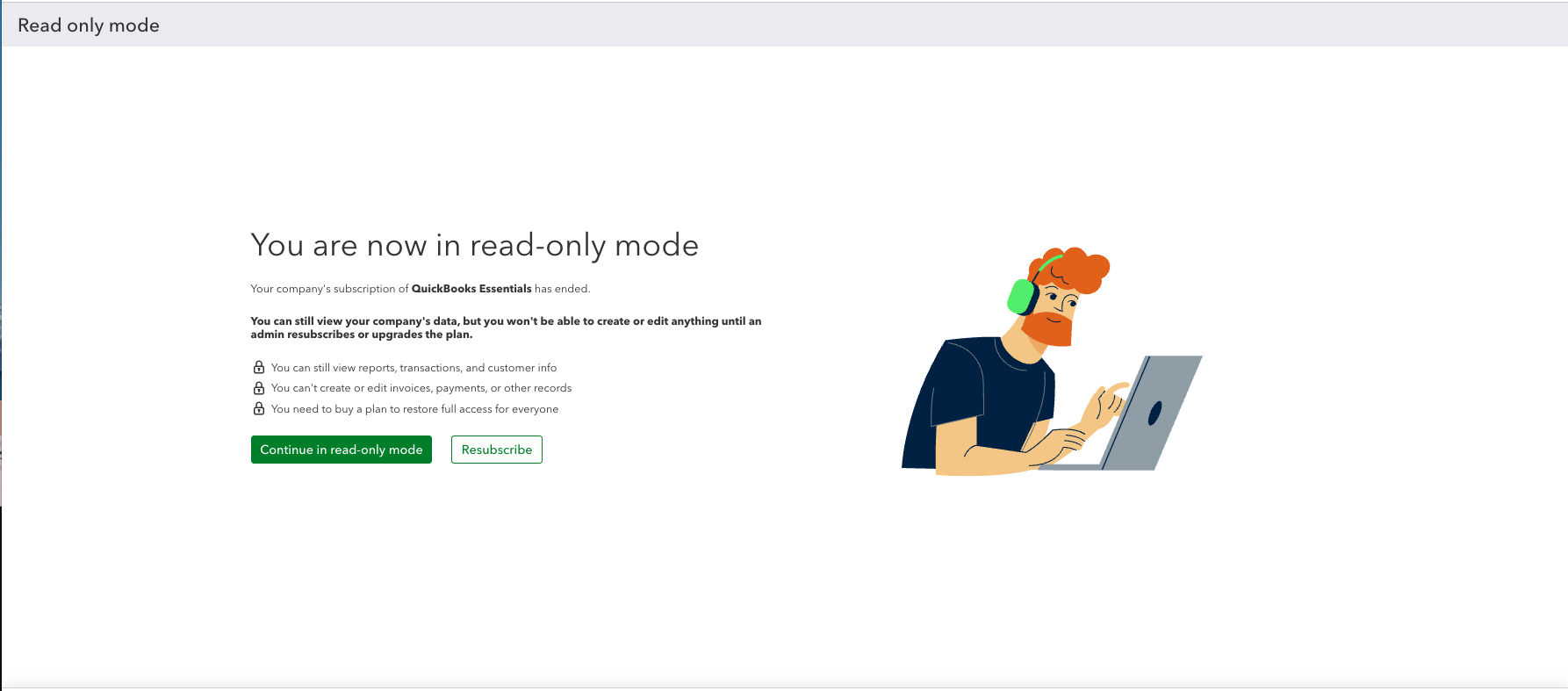
And it is genuine. The billing page now reads “Read only until 09/10/2027,” a year to the day, and reports run against the full dataset. We pulled a balance sheet after expiry and every figure was still there.
Two honest caveats. Choosing “Continue in read-only mode” does not land you on your dashboard; it opens a resubscribe form asking you to update your company profile, which you have to dismiss to reach your own books. And a persistent banner sits over every page telling you access is paused. It is read-only access with a salesperson standing in the doorway.
One more detail worth knowing, because it cuts the other way. The card we could not remove during the trial vanished from the billing page the moment the subscription ended. The payment method row is simply gone. The card you are not allowed to delete is deleted for you once there is nothing left to charge it for.
Xero: a clean lock
Xero did precisely what its dialog said, on the day it said. Access stayed fully open through the end date, which meant the books were exportable right up to the last evening. The next morning:
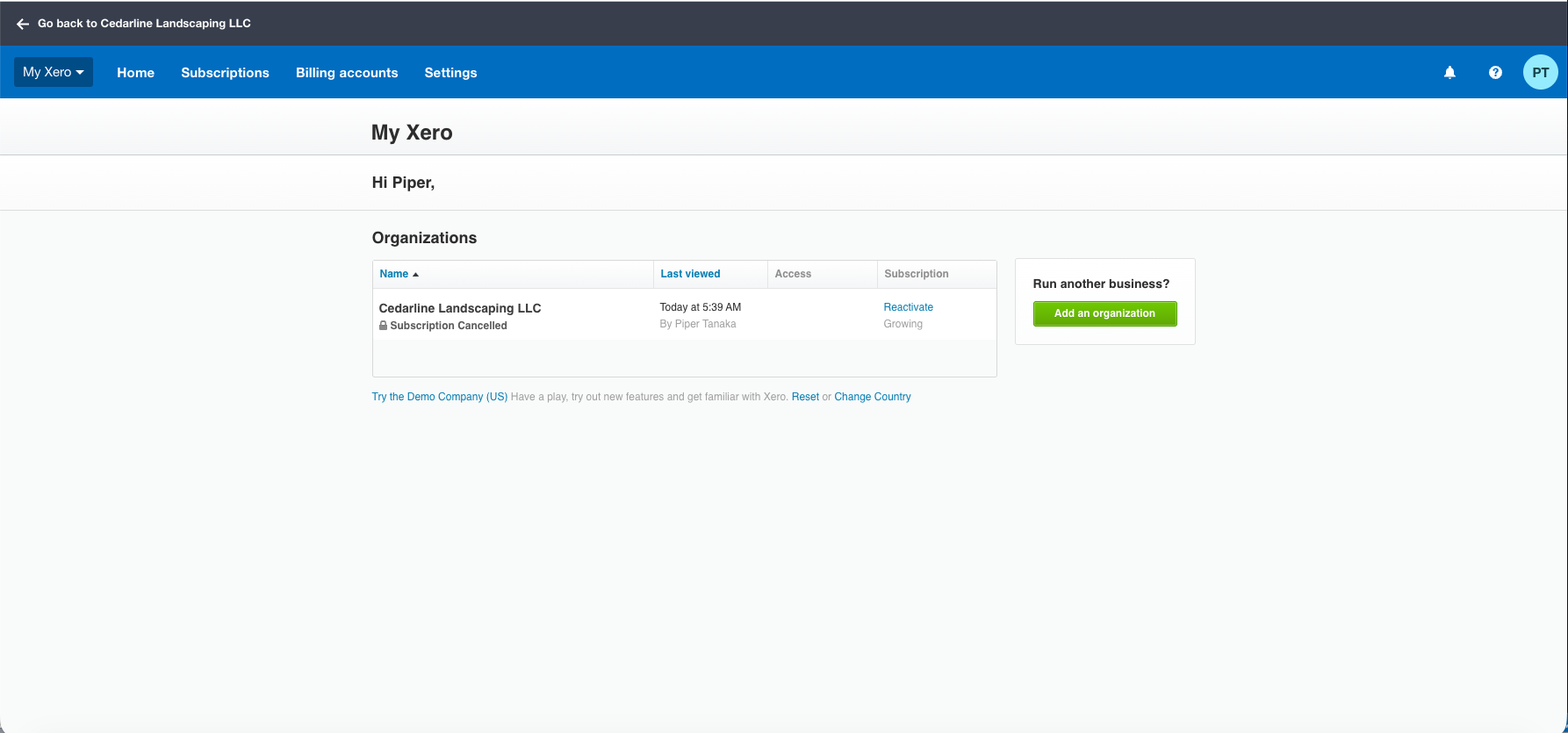
No read-only period, no retention statement anywhere, and no email. Eight days after we cancelled and a day after the organisation closed, Xero had still never sent a cancellation confirmation of any kind. For a vendor that sent an unprompted week-ahead billing warning, that is a strange gap: it told us before it would charge us, then said nothing at all when we left.
The lock is not unreasonable on its own terms, since reactivation restores everything. But the only warning to export came from one line in a dialog you see once, and there is no window afterward.
The three that took no card
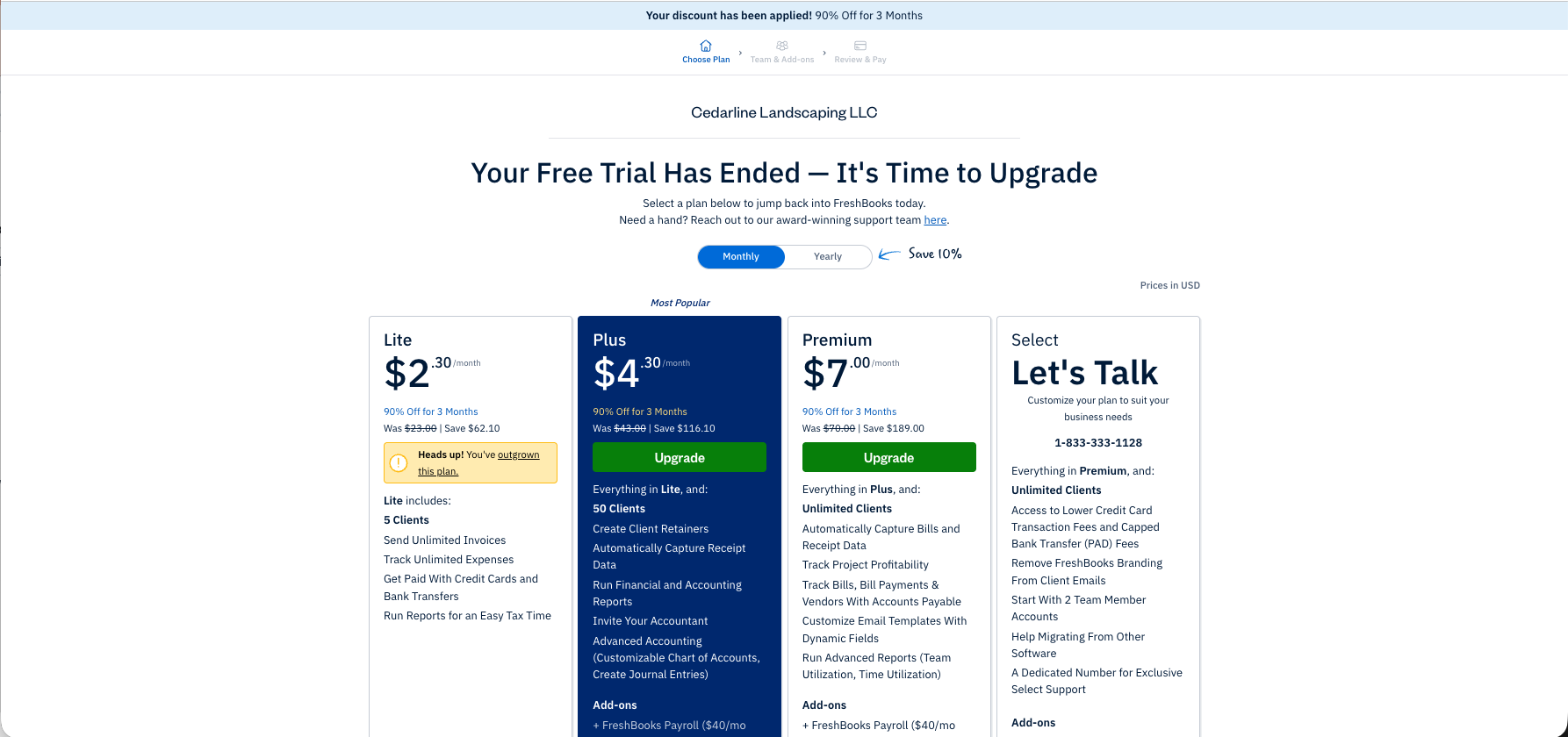
FreshBooks replaced the product with a three-step checkout. No dashboard, no read-only view, no export, no statement about what happens to the books. The 90%-off promo pre-applied at the wall is the same promotion that was on the public pricing page in August, presented here as a personal discount. The warning we got four days earlier had mentioned no plan, no price and no date; the only place any of that appears is behind the login, after it is too late to act on.
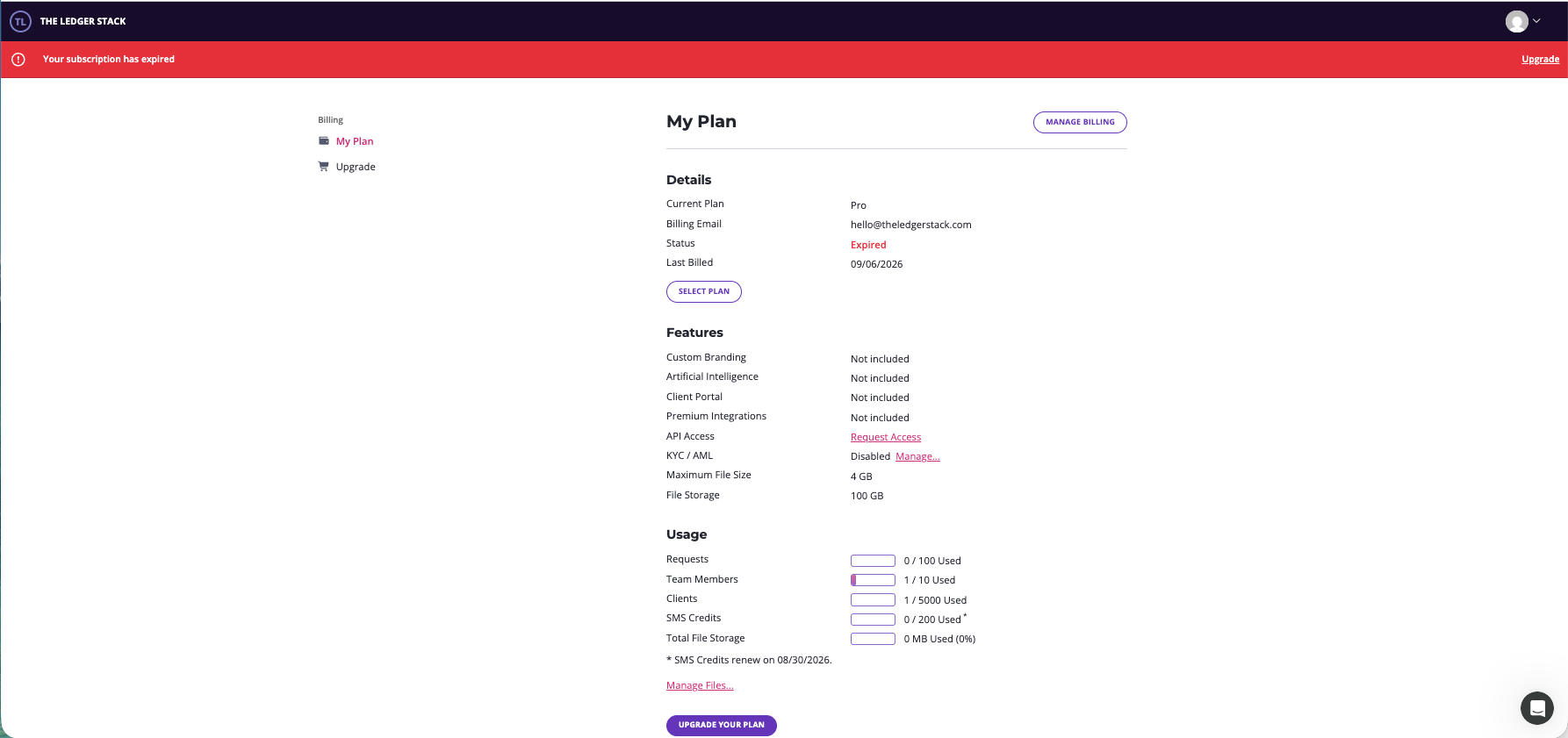
Content Snare was much the same, with an extra twist. The navigation is stripped out, request links redirect to the billing page, and the one remaining link on that page, “Manage Files,” throws a session-expired screen and logs you out. We reproduced it on a fresh login. There is no export window and no stated retention period, and the usage panel keeps cheerfully counting the client and the storage you can no longer open.
Its pre-expiry email had arrived two days out, accurately dated, which is better than FreshBooks managed. But the email was a sales pitch: a Matrix-themed choice between plans, some unsourced statistics, and a bonus offer that started one tier above the plan we were testing. On expiry day itself the only message we received was a marketing piece about handling difficult clients. Nothing ever said the trial had ended.
Ignition: the one that took the client down too
The other two walls cost us our own access. Ignition’s cost us our client’s.
During the trial we had sent a proposal, exactly as a real firm would. Three days after the trial lapsed we opened that proposal link the way the client would have:
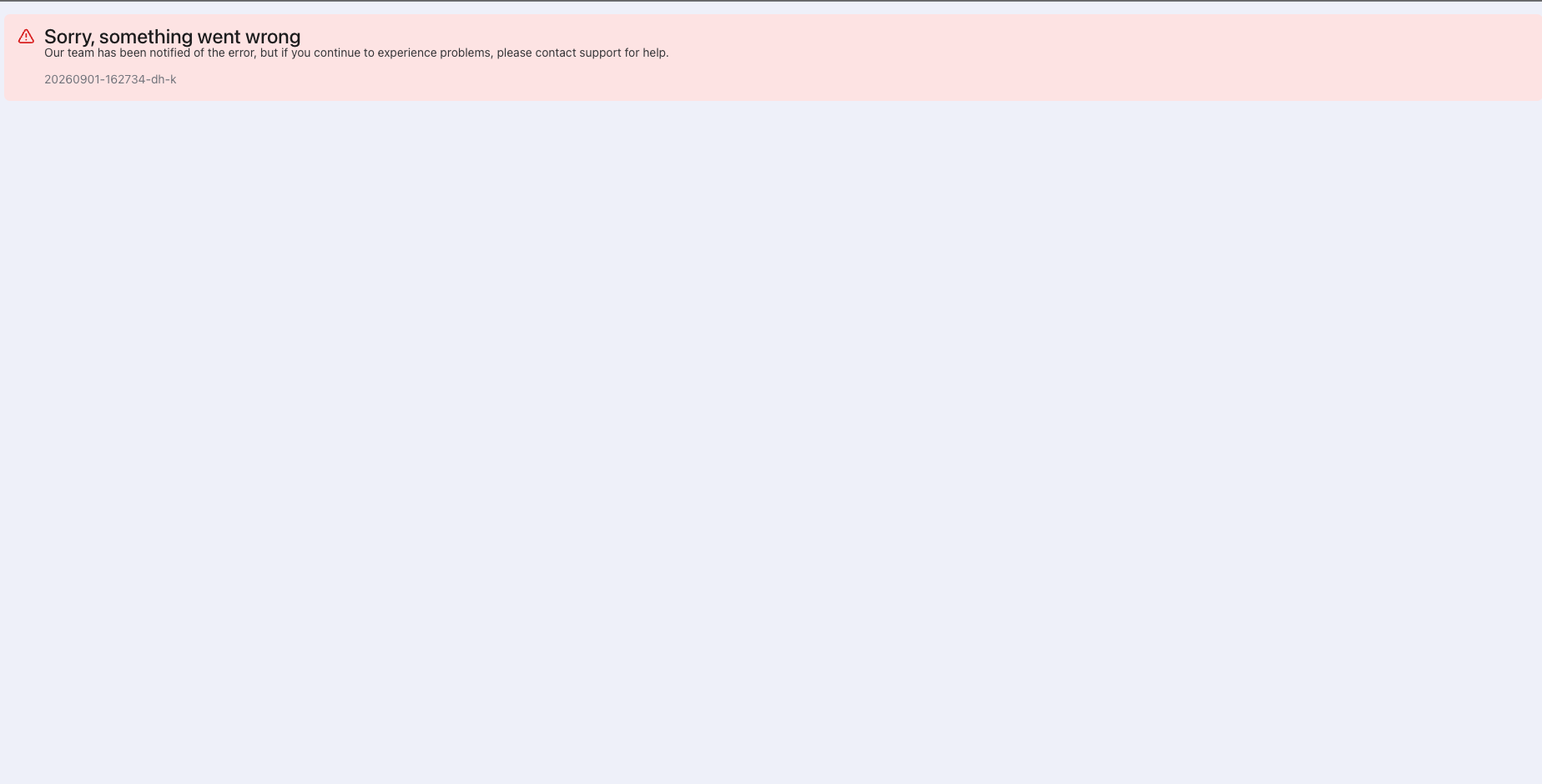
There is no “this proposal is no longer available.” There is no branding and no mention of the firm that sent it. A small business owner clicking the link their bookkeeper sent them gets a crash page telling them to contact Ignition’s support.
Our own side was locked the same day, behind a plan chooser, with no read-only mode and no export. So the firm cannot open the record, cannot see whether the proposal was ever viewed, cannot retrieve what they sent, and cannot reach the client through the tool. And nothing in any email warned that this was coming. The only message Ignition sent our firm inbox in thirteen days arrived the morning the trial expired, and it was a discount:
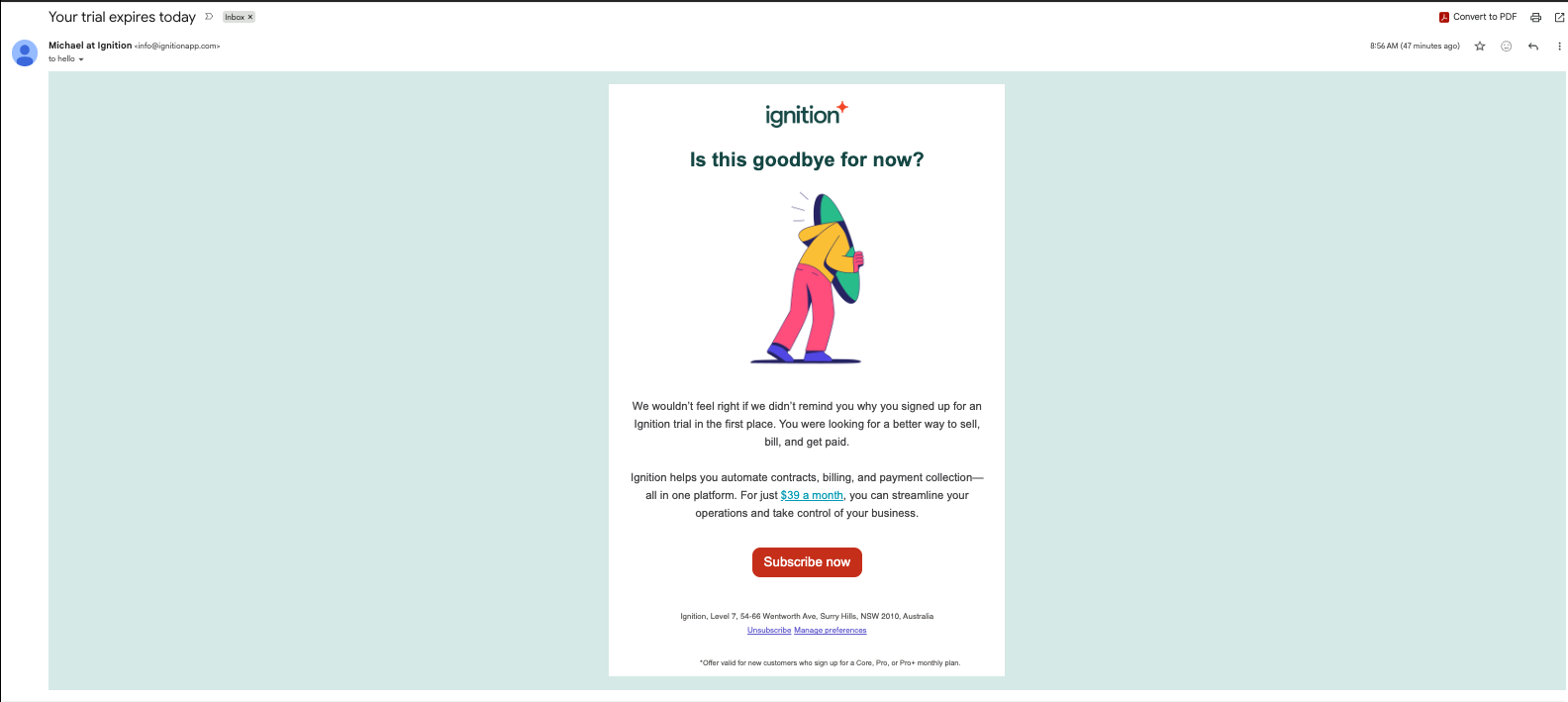
Worth reading that one closely. The headline says $39 a month. The footnote limits the offer to Core, Pro or Pro+ monthly plans. We verified in Ignition’s own plan chooser that $39 is the Solo tier billed annually, which the footnote excludes twice over, and that the cheapest plan the offer actually covers is Core at $149 monthly. That is 3.8 times the advertised figure.
The full account of both tools is in our Content Snare versus Ignition review.
What we would tell anyone starting a trial
The pattern across all five is simple enough to state in a sentence. The vendors with a billing relationship to protect told us what happens to our data. The vendors with nothing to bill had no reason to, and did not.
“No credit card required” is a real kindness in one narrow sense: nobody can charge you by accident. It turns out to say nothing about whether you will be able to open your books next week.
The last one is the expensive lesson, and it is the reason we ran this experiment on a fictional company instead of a real one.
Every trial here was started with our own money or no money at all, and none of these vendors knew a review was underway. We cancelled the two card-holding trials before their charge dates and confirmed afterward that nothing was billed. Prices and terms were read from each vendor’s own pages, dated, and tracked on the pricing tracker. Since these trials ended we have joined the affiliate programs of two of the five tools above, Content Snare and Ignition, and we are saying so here rather than in a footer: we are promoting Content Snare as part of an affiliate agreement and may earn affiliate commissions on your purchase. Neither arrangement existed while any of this was observed, and you can see for yourself that neither has softened what we found. Our test books are downloadable if you want to run the same experiment and check us.
Filed under: quickbooks · xero · freshbooks · content snare · ignition · free trials · original research